


ErgoCert performs several types of ergonomic assessments (with or without advanced technical sensors) on PRODUCTS and WORKPLACES, including:
An Ergonomic Test Report (RPE - Rapporto di Prova Ergonomica) is drawn up after every assessment, detailing the applied regulatory framework, the tools and methods used, and the results obtained.
ErgoCert assesses the physical and cognitive interaction between users and products, applying state-of-the-art tools (pressure sensors, wi-fi motion capture systems, eye-tracking, VR glasses, sensorized gloves, biomechanical modeling packages, etc.) in order to obtain TECHNICAL-SCIENTIFIC EVIDENCE allowing a simple and clear understanding of the ergonomic assessment results.
In order to do so, we worked for over ten years in the field and alongside the University (since we used to be an academic spin-off of the University of Udine) to develop methods, procedures, and innovative technical tools aimed at obtaining quantitative data useful for ergonomic assessments both in the lab and in the field. Below you will find some of the tools and methods we have set up in all these years of research and development, which we use in order to obtain objective evidence in the various assessment contexts businesses request from us.
Nowadays, working with highly reliable numerical values compliant with the international regulatory frameworks, it is possible – on the one hand – to quantify and weigh possible ergonomic issues and – on the other hand – to show one’s customers and stakeholders the good quality of one’s marketed product or of the solutions adopted on one’s production lines, offering the qualitative information that allows final users to develop a trusting relationship with the company.
Ever since the first applications in 2009, as a spin-off of the University of Udine, ErgoCert has been aiming at objectifying a growing number of ergonomic risk factors, applying hi-tech tools and developing specific protocols to collect and analyze data.

This has been done in order to overcome limits and inaccuracies due to the observational nature of the current assessment methods for the biomechanical overload, which imply both a non-negligible effect of the assessor’s subjectivity and difficulty in evaluating complex situations (e.g., long work cycles).
Our innovative approach has allowed us to:
In 2022, our assessment and ergonomic risk management modes were honored by Eu-Osha (European Agency for Safety and Health at Work - Bilbao) as good practice on the occasion of the campaign “Healthy Workplaces” (“Lighten the Load” Award).

The tools used during inspection have been chosen on the basis of their practical applicability on a large scale in production contexts (production site mapping):
The application of such tools does not significantly increase the typical reading time and allows to base the subsequent analyses on quantitative instrumental data.
Whether possible, the instrumental surveys include 2 operators per workstation, representative of the anthropometric extremes (5th and 95th percentile), repeatedly performing the relevant work cycles.


Inertial Motion Capture System for detecting the actual movements and postures enacted by users.
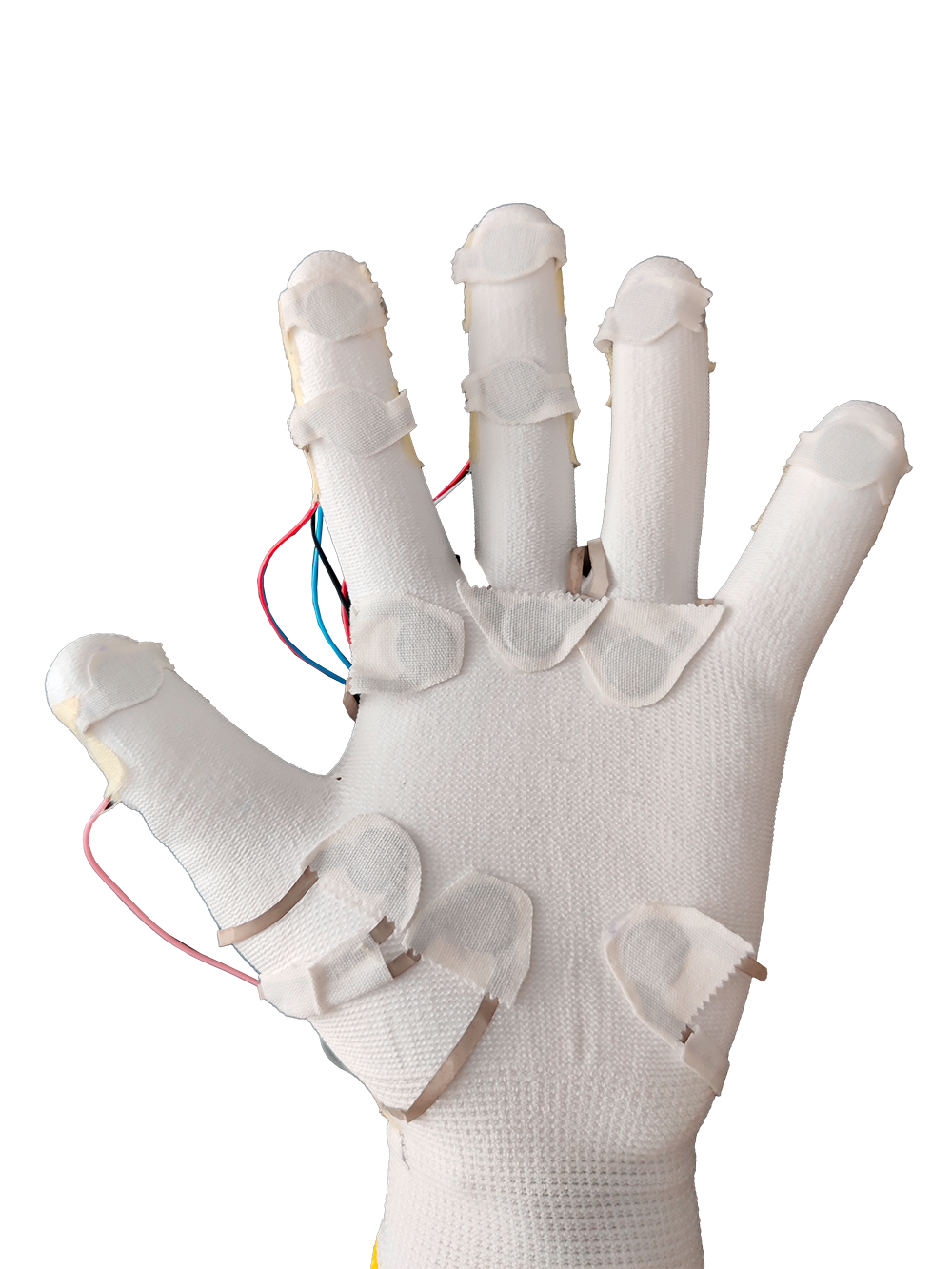
Sensorized glove in order to detect the timing of contact between the hand and products/work tools and the hand force used.
Dynamometer used to measure the intensity of a force, in relation to pull-push actions or force operations.
ErgoCert has developed proprietary algorithms and software for the instrumental data analysis and the risk index calculation (NIOSH, OCRA, REBA, EAWS, etc.):


ErgoCert Analyzer
Movement frequency and maintenance of static incongruous postures of the upper limbs and the lumbar and cervical spine, hand vertical and horizontal position (NIOSH), OCRA automatic precalculation, kneeling and crouching posture detection, REBA index precalculation.
ErgoCert EAWS Analyzer
Full-body posture automatic detection (section 1), applied manual force and types of grips (section 2), manual handling of loads (section 3).

BoB (Biomechanics of Bodies)
Assessment of intradiscal compressions and muscle activations.
Following the data analysis, ErgoCert issues several types of reports:
-Movement and posture computerized analysis
-Force and hand posture analysis
-Test report for the issue of the Ergonomic Risk Assessment Document (DVR)